


ST MARY’S, STOTT HILL – THE MOTHER CHURCH OF BRADFORD, 1825-2025
July 2025 marks the bicentenary of the opening of St Mary’s Church, Stott Hill, the first Catholic place of worship to be built in Bradford after the Reformation. Using material in the Leeds Diocesan Archives, James Hagerty and Robert Finnigan recall the foundation of the Bradford Mission and its subsequent expansion during the nineteenth century.
The Nineteenth Century Church
In 1688 Pope Innocent XI divided the then missionary countries of England and Wales into four Vicariates or Districts – London, Western, Midland and Northern. Bradford was in the Northern District which covered the six northern counties of England. In 1840 Bradford was in the new Yorkshire District, and after 1850 it was in the Diocese of Beverley, following the Restoration of the Hierarchy. Since 1878 it has been part of the Diocese of Leeds.
Catholics in early Nineteenth Century Bradford
For the first twenty years of the nineteenth century the few Catholics living in Bradford had to walk to Leeds to attend Mass at St Mary’s Chapel in Lady Lane, which had been established in 1794. Over the years several attempts were made to hire premises in Bradford for Catholic worship but each time local opposition compelled the town’s Catholics to find alternative rooms, first in Commercial Street, then at the Roebuck Inn, Ivegate, and later still on Well Street and Nelson Street.
The passing of the Catholic Relief Acts in 1778 and 1791, and the Catholic Emancipation Act of 1829 enabled Catholic chapels to be built and removed legal strictures against Catholics, but the legislation did not make life much easier for the faithful. The influx of Irish poor, predominantly Catholics, and their calls on the Poor Law authorities for relief caused much public antagonism. In the face of social opposition and poverty, buying land on which to build a Catholic chapel was difficult. The ‘Popish Mass’ still caused considerable consternation among the wider public.

William Harvey’s view of mid-19th century Bradford
St Mary’s, Stott Hill
In the 1820s Catholics formed a growing portion of Bradford’s population, which totalled approximately 60,000. Priests were sent from Leeds to minister to them and Fr Francis Murphy obtained land on which a new chapel could be erected. Ironically, it was situated in Stott Hill 100 yards across the road from the Anglican Parish Church of St Peter.
In 1824 the Catholics of Bradford launched an appeal for funds to help them build the new chapel:
The Catholics of Bradford, amounting in number to more than 400, and consisting exclusively of the working class, beg leave to appeal to the charity of those of their brethren whom God has blessed with more ample means…by assisting their poor brethren to raise a temple for the worship of the living God.
Hitherto the project had been supported by the ‘poor Catholics’ of Manchester, Leeds and Bradford but the funds thus raised were proving inadequate to the task in hand and the Bradford Catholic community faced the prospect of accumulating a debt amounting to £1,000.
Bradford’s Catholics were, therefore, obliged to appeal to the opulent of their communion for their charitable co-operation in completing a work which will do credit to the Catholic cause…it will be, when completed, one of the neatest Gothic structures in Yorkshire.
St Mary’s Chapel was consecrated on 28 July 1825. Hundreds gathered long before the start of the opening Mass which lasted 1½ hours. Fr Benedict Rayment of York was the Principal Celebrant and Bishop Peter Baines, Vicar Apostolic of the Western District, preached the sermon. In later years the chapel was variously named St Mary on the Hill, Mont Ste Marie and Mount St Marie. Later it was called Old St Mary’s Church. It was reportedly ‘a very handsome structure, in the Gothic style, with lancet windows’. The cost of erecting the chapel amounted to approximately £2,000 but in 1839 it was enlarged, and a school and a presbytery were added at an outlay of an additional £2,000.
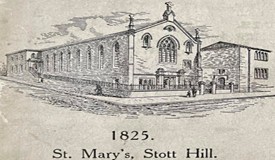
It is noteworthy that in 1825 only three towns in West Yorkshire possessed a Catholic chapel – Leeds (St Mary’s), Pontefract (St Joseph’s) and Bradford. These would be joined in the following decade by St Austin’s, Wakefield in 1828, St Patrick’s, Leeds in 1831 and St Patrick’s, Huddersfield in 1832.
Pressure for extra space for both worship and the education of the young was made more urgent by the arrival in Bradford, in the 1840s, of more immigrants from Ireland as a result of the Great Famine. Sodalities and other community activities were introduced including a Children’s Guild formed in 1839 to care for the education of young Catholics. In 1841 230 boys and 250 girls attended Fr Kay’s Sunday Schools at Stott Hill.
On 28 July 1850, twenty-five years after the opening of St Mary’s, a Mass of Thanksgiving was celebrated at 5.00 a.m. with over 400 people attending before going to work. Other Masses were held throughout the day. In 1851, the Religious Census recorded that there was seating for 380 people at St Mary’s and that there was a congregation of nearly 4,000.
The new St Mary’s
Such was the growth of Bradford’s Catholic population in the mid-century, due largely to Irish immigration, that St Mary’s could not accommodate the numbers attending Mass or other services. Fr Kay had enlarged the chapel in 1839; an organ was installed; a presbytery and a school were built adjacent to the chapel; and the cemetery was opened but such developments proved inadequate. The solution was the opening of chapels-of-ease, especially in areas inhabited by the Irish Catholics, and the building of a new church to replace St Mary’s on Stott Hill. On 12 September 1874 the foundation stone of the new St Mary’s on East Parade was laid by Bishop Robert Cornthwaite, Bishop of Beverley – and later, the first Bishop of Leeds.
St Mary’s new church was opened on 3 May 1876, in the presence of Bishop Cornthwaite and Bishop Bernard O’Reilly, Bishop of Liverpool. A contemporary account stated: ‘The number of priests attending was very great and the benches in the nave were crowded to the very doors with the ranks of the faithful…this was a very great celebration and must have filled the souls of all assisting with enthusiastic devotion.’ Mgr Capel, a distinguished guest, stressed the importance of the new church not only in the life of Catholics but also in the life of prosperous Bradford, a city of ‘religious liberality’. Much had changed since 1825.

St Mary’s Church, opened 1876
The Priests and the expansion of the Church in Bradford
Baptismal registers provide some details of the early priests at St Mary’s. The names of seventy priests appear between 1822 (when the records begin) and 1876, when the new church opened. Some names occur only once, while others stayed long enough to be instrumental in the development of the chapel, the church and the establishment of schools and mission life. Fr Patrick Ryan and Fr Brennan ministered at Stott Hill from 1822 to 1823. Fr Francis Murphy, from County Meath, was ordained in 1825 and volunteered for missionary work in England. He was at St Mary’s between 1825 and 1827. Other priests included Fr Maddocks (1827-1834), Fr John Rigby (1834-1841), Fr Peter Kay (1833-1843), Canon Thomas Harrison (1843-1860), Fr William Arnold (1843-1847), Fr Vincent Eyre (1845-1850), Fr Thomas Lynch (1850-1854), Canon James Illingworth (1861-1865) and Canon John Motler (1865-1881). Canon Thomas Simpson ministered as Rector from 1881 until 1913.

Canon John Motler, Rector, 1865-1881
Bradford’s population increased significantly in the second half of the nineteenth century and so too did the number of Catholics. Chapels-of-ease were opened but it was not long before more missions, permanent churches and schools were established. In 1852 the new mission of St Patrick’s was opened in Westgate; and this was followed by St Walburga’s Shipley, in 1863; in 1868 St Joseph’s was opened in the Manchester Road area; in 1871 St Peter’s, Leeds Road, was established; in 1872 St Ann’s, Guy Street, was opened; in 1878 St Cuthbert’s, Heaton, was opened; and in 1882 St William’s, Ingleby Road, was established.
In the eighty years after 1825, Bradford’s Catholic population grew exponentially, and the local Church responded successfully to provide spiritual care, chapels, churches, schools and burial grounds for the faithful. The nineteenth century was marked by significant challenges for the Church in Bradford but could truly be called an age of expansion. The next hundred years would be equally challenging, albeit in very different ways.



Recent Comments